Showing posts with label - Japan (Kansai). Show all posts

Sunday, May 18, 2014

Discovering Fushimi Inari Shrine and Nara

The final run of Kyoto before landing ourselves to the retreat of Nanten En Ryokan, Osaka (read here), we managed to visit several places within Kyoto vicinity, which include the Fushimi Inari Taisha (伏見稲荷大社) located in Fushimi-ku, Kyoto, Japan. 


Getting here from Kyoto Station is easy, just follow the JR Line to Inari Station and you will arrive to the shrine. This Shinto shrine is at the base of the sacred Mount. Inari and is most famous for its thousands of vermilion torii gates, that trails up to the 233m high mountain. Fushimi Inari is dedicated to Inari, the Shinto god of rice. Foxes, perceived as the divine Inari's messengers, can be seen in forms of statues here.


The torii gates along the entire trail are donations by individuals and companies. Minimum donation can reach up to 400,000 yen :O

This place is constantly dense with visitors and getting that lone shot at the shrine is really challenging. Shutterbugs and models alike have to be quick, really quick. And of course, a few restaurants here offer locally themed dishes such as Inari Sushi and Kitsune Udon ("Fox Udon"). The hike up may take up to 2 hours, a time luxury we did not afford because of we wanted to visit Nara next.


Nara (奈良市) is the capital city of Nara Prefecture located in the Kansai region of Japan. Getting to Nara from Kyoto station costs approximately ¥710 via the JR Nara Line. Nara, most famous for its roaming, tame Sika deer, especially in Nara Park. It is said that the mythological god Takemikazuchi arrived in Nara on a white deer to guard the newly built capital of Heijo-kyo. The deer is regarded as heavenly animals, protecting the city and the country, and they are protected creatures in this prefecture. You may purchase "shika sembei" (deer biscuits) for ¥150 to feed the deer. 

RAWR!

Though the deer are tame, be advised that they are animal, and they do have the tendency to go wild sometimes. :P
Autumn View near Todaiji
Tōdai-ji (東大寺, Eastern Great Temple),is a Buddhist temple complex located in the city of Nara, Japan. The Great Buddha Hall/ Daibutsuden (大仏殿), houses the world's largest bronze statue of the Buddha. This is one of the few temples where they actually allow photography within the temple itself. 
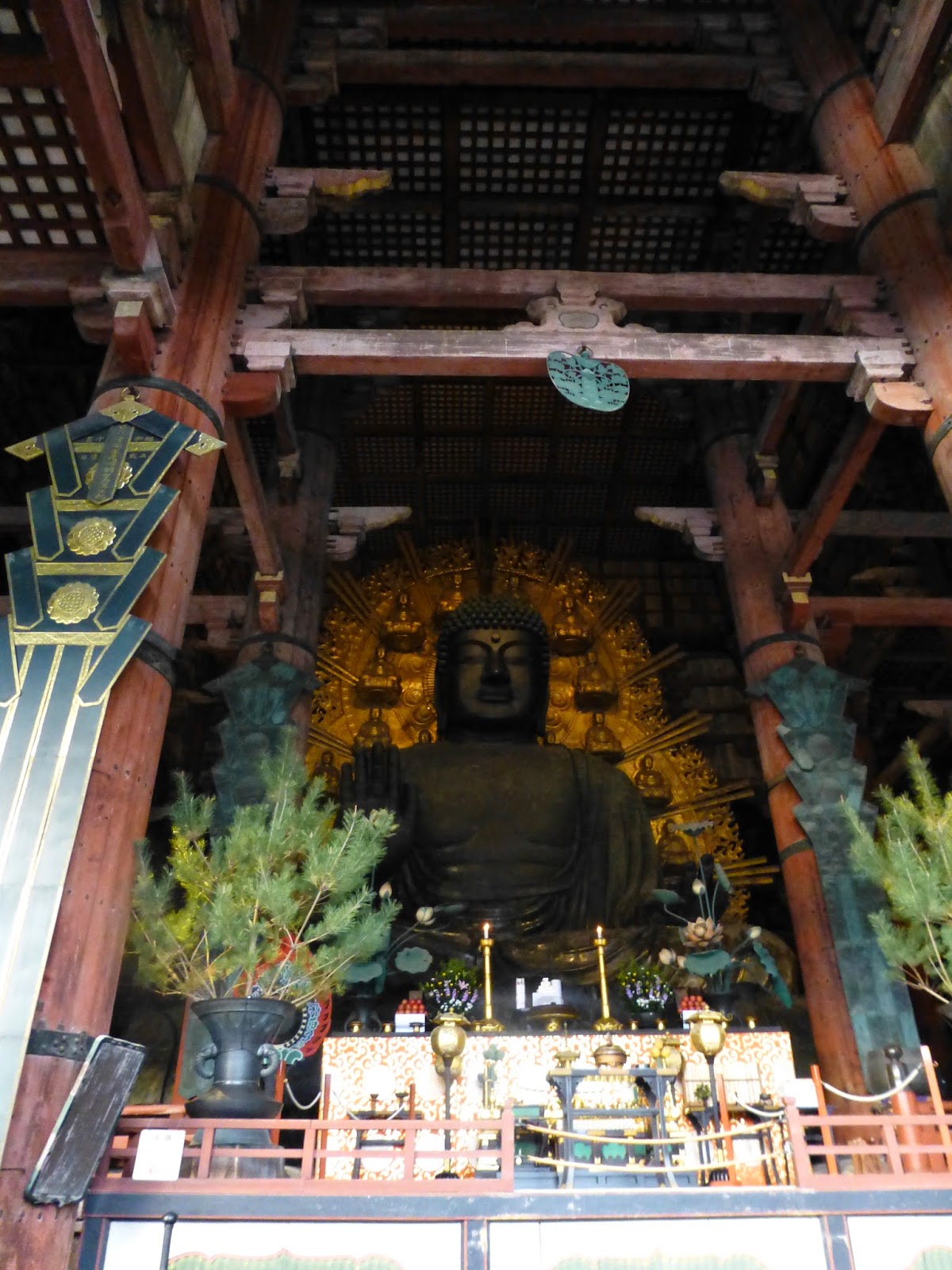


Don't miss the Binzuru at the entrance of the Todaiji. The common belief that if you rub a sick part of your body against the corresponding part of it on the Binzuru statue he will cure you. *Rubs soul*

Le Binzuru
It was indeed worthwhile to drop by Nara. Aside from Todaiji, you can explore Nara more with Kasuga Taisha and the Kofukuji Temple (Read some of them here), both of which we did not manage to visit due to the rush we had to get to Osaka.


Nara is quite a dainty place to visit, and we then proceeded to our next stop Osaka next. I wouldn't mind visit Nara again :)

Sunday, January 12, 2014

Discovering Kyoto - Arashiyama & Kinkaku-ji

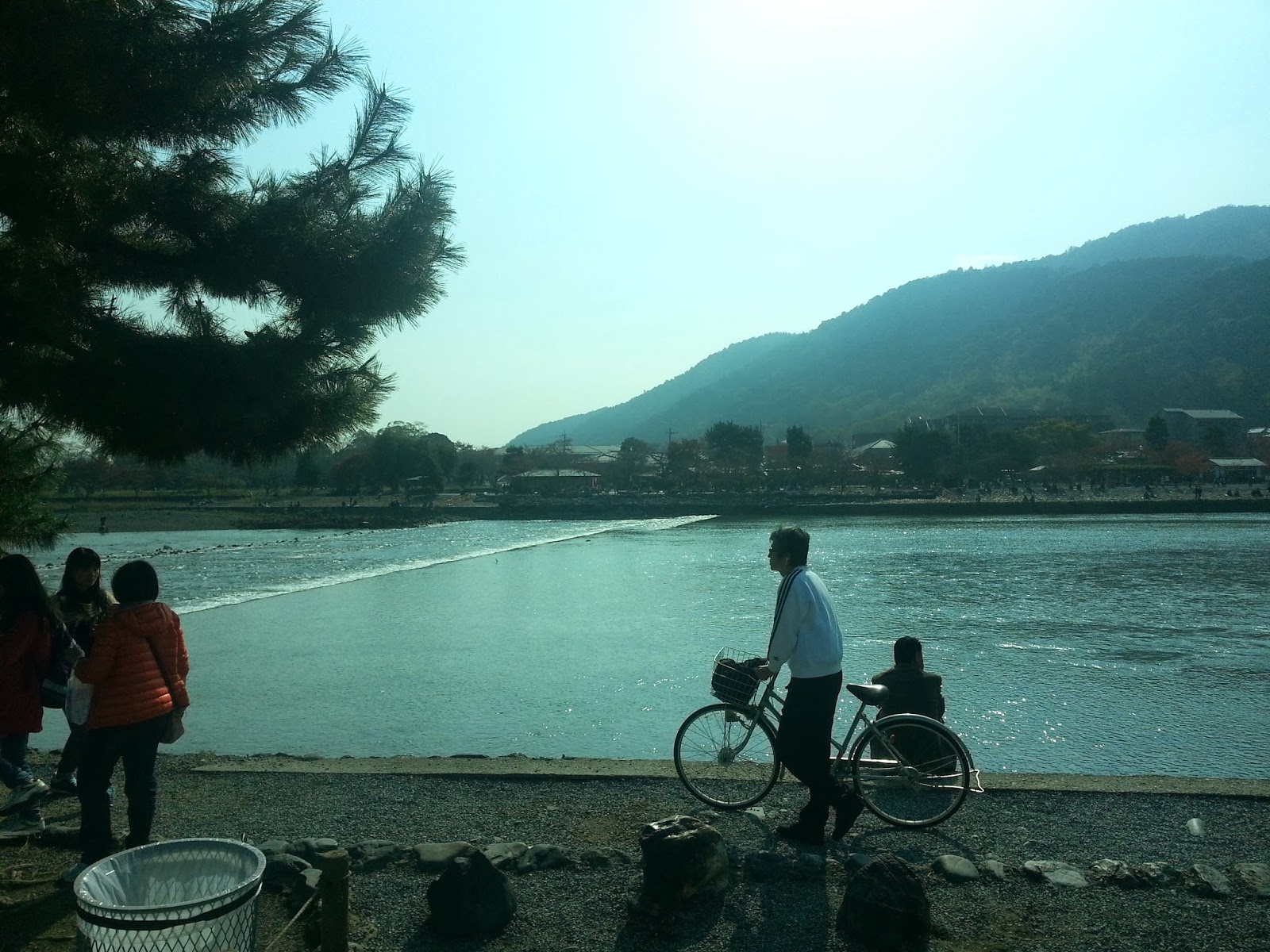
If you're around Kyoto, it is good to venture out the outskirts, particularly Arashiyama (嵐山, lit Mist Mountain). The natural setting of the pristine river with the scenic mountain that backdrops it makes Arashiyama a popular tourist district. We went there about a week too early to see the more vibrant autumn leaves, but it was still very breathtaking non the less.


The most iconic landmark in Arashiyama is the Togetsukyo (渡月橋, lit Moon Crossing Bridge). Spanning the Katsura River, this wooden bridge is one of the best place to enjoy the spectacular views that Arashiyama has to offer.


We met up with one of my friend's friend's mum (hereon known as okāsan) for lunch. We headed to Nishiyama sōdō (西山艸堂, lit Western Hill Church Cottage?) for some Kyoto tofu dish. To those carnivores, sorry to say that this place specialized in only tofu and vegetarian dish, up scaled to atas level that is. Vegan paradise to say the least. 


This rustic Japanese restaurant allows you to enjoy the luxuriant greenery views of the garden while seated on traditional Japanese cushions at the dining area. One should not underestimate the servings of the tofu. Despite them all being veges, one can be quite contented with the dishes served, at least for me that is. It values up to approximately 3150 yen per person, probably the dearest tofu I had in my life, ever. (Special thanks to okāsan :D )


Our next stop was Arashiyama's famous bamboo groves, the Sagano Bamboo Forest. Noted as one of Japan's national treasure, this 15 km² area of bamboos invokes a certain tranquility along the walk. You may want to choose a weekday to venture this area, as this place is quite packed during the weekends (both tourists and locals alike).


Arashiyama offers a lot of the other attractions, such as the Tenryū-ji (天龍寺), Iwatayama Monkey Park and Katsura Imperial Villa, which we did not cover due to time constraint (autumn, despite the more photogenic, vibrant colours, we lost out on daytime), we opted to Kinkaku-ji (金閣寺, lit Temple of the Golden Pavilion) instead. 


Designed based on the Muromachi period garden, this minimalist themed landscape is a National Special Historic Site of Japan. The Golden Pavilion, is one of Kyoto's most photographed building, contributing to the large number of visitors annually. They do have small shops that sells charms and fortune telling around as well (it's towards the exit, you can't miss them).

Getting from Arashiyama via Kyoto Station, takes approximately 50 minutes (depending on traffic that is), so make sure time is planned wisely for to and fro journey (check Google Maps for route suggestion). I would suggest a full day in Arashiyama, but if you want to slot Kinkaku-ji in the day as well, it is an hour journey (suggestion by Google Maps). 

All in all, it was a good day, despite moving at a very fast phase, Arashiyama did not fail to disappoint. Despite reaching Kinkaku-ji almost towards its closing time, we were in awe by the perfectly crafted Golden Pavilion, worth the effort of rushing towards here. I'll admit, better time planning should be done by our end, but non the less, that's what makes traveling much more fun than being 100% schematic, no? 

Monday, January 6, 2014

Discovering Kyoto - Kiyomizu-dera and Higashiyama Street

Apart from the rapid modern development of Tokyo, what reflects Japan at its best would definitely be Kyoto (京都). Located in Honshu, it has a population of 1.5 million and formerly the imperial capital of Japan.


My travel mates and I slotted Kyoto on the 15th of November 2013, after our 2 days trip in Tokyo. Survived the long, overnight bus ride via Willer (don't get me wrong, the bus service is good, but the overnight journey and basically almost zero sleep on the bus is not) from Tokyo to Kyoto, about 8 hours journey.

Autumn Scenery

Kiyomizu-dera's most photographed view (minus the poser in there of course)
First thing we did was to check in our hostel, J Hopper Kyoto. You can tell that they're seasoned in the accommodation line as the receptionist is fluent in English, and very resourceful in helping us to plan our Kyoto sight seeing routes. Plus, I would say that their hostel, albeit giving a little of the rustic, Japanese house feel, it is very equipped with state-of-the-art toilet (yes, I can't seem to get over the fact that I love Japanese toilets, bear with me, I come from Malaysia), wi-fi and clean hostel all together. Would recommend J-Hopper anytime!

Reception area at J-Hopper

After checking in, we made our way via bus (which I need to emphasize, the buses are punctual) to Kyoto's famous temple, Kiyomizu-dera (清水寺, lit Clear Water Temple). An independent Buddhist temple in eastern Kyoto. The temple is part of the Historic Monuments of Ancient Kyoto, and probably the most visited temple (both by tourists and locals) in Kyoto. From the most pictured veranda of Kiyomizu-dera, it was said that those who took the plunge (and survived), their wish would be granted. Of course, that is illegal today, but I wonder if I would take the jump, what could possibly happen? (Bungy potential here).


Several shrines are located close to Kiyomizu-dera as well, including the famous Love Stone in the Jishu Shrine. #Foreveralone people may change their fate by attempting to walk from one love stone to another (about 6m apart) with their eyes closed. If succeeded, they can find the love of their life (jeng jeng jeng).

Charms being sold for luck/love/invisibility power
The Love Stone


Also, you should visit the Otowa Waterfall, located at the base of Kiyomizudera's main hall. Separated into three streams, and visitors use cups attached to long poles to drink the water from the waterfall. Each stream's water is said to have a different benefit, namely to cause longevity, success at school and a fortunate love life. I personally had no idea which one I took (I recalled taking the one far left, facing the waterfall) but anyhow, any blessings that is available, I'll take it.


Eating in Kiyomizu-dera, probably not the best place to find great food. The servings are decent, for sure, but you're better off finding your fix of food at the nearby streets of Higashiyama. The narrow lanes and the adjacent, rustic wooden Japanese shop lots do invoke the feeling of being in the old Japan. Recommended for souvenir shopping, snacks and having your lunch if you fancy the more traditional taste of Japanese food. Within walking distances are the Yasaka Shrine, Yasaka Pagoda, Kodaiji Temple and Heian Shrine.


I would personally recommend a whole day to venture starting from Kiyomizu-dera and make your way around Higashiyama to the various shrines that surrounds the region. As recommended by japan-guide.com, walkers can also make their way to the Philosopher's Path for the Ginkakuji Temple. Time constraint on my end, as we only made it half a day here. Never the less, your trip to Kyoto should encompass here, otherwise you probably have not seen Kyoto :)

PS: Extra pictures taken from around the area

Taken at the Kannon Ryozen memorial temple